
Two spoiler-lite reviews for late summer: The Death of Vivek Oji (2020) and Little Rot (2024) linger on the psyche like glistening oil on freshly fried plantain or tacky body fluids on tired skin—delightful or disgusting depending on the glint in one’s eye.
Farewell August!
I’ve spent late summer falling back in love with the simple pleasure of reading physical books in the sunlight. My most recent reads were both by the incredible Akwaeke Emezi who stole my reader’s heart with their 2019 Young Adult speculative fiction book, Pet about uncovering and defeating monsters in the face of communal disbelief and their 2018 semi-autobiographical fiction novel, Freshwater about a woman living with two omnipotent, volatile and careless gods inside of her mind. Both books were wholly unlike anything I’d ever read before and earned Emezi a spot on my list of favorite authors.
(I’ve also read their debut ‘romance’ novel You Made a Fool Out of Death with Your Beauty which was joyfully bonkers, but chaotically incoherent in a way I failed to connect with. It also caused quite a stir in my book club. I still love to discuss this book with others because the conversation is certain to be amusing given the novel’s gasp-inducing second act plot twist.)
After reading The Death of Vivek Oji (2020) last weekend, I hurriedly scurried to YouTube in search of an author interview to help me make sense of the text. Luckily, Vroman’s Bookstore delivered with a recording from six years ago, nearly to the day. In conversation with Carla Bruce-Eddings, Emezi said, “I’m always interested in transgressive topics…I want to put [them] in a book in a way that…kinda challenges what are the things you think you’re okay with and the things you think you’re not, and the ways that language can influence that.” The quote echoes in the back of my head through this weekend’s reading of Little Rot (2024). Though the books couldn’t be more different in style and substance, both caress discomforting ideas with tender empathy.
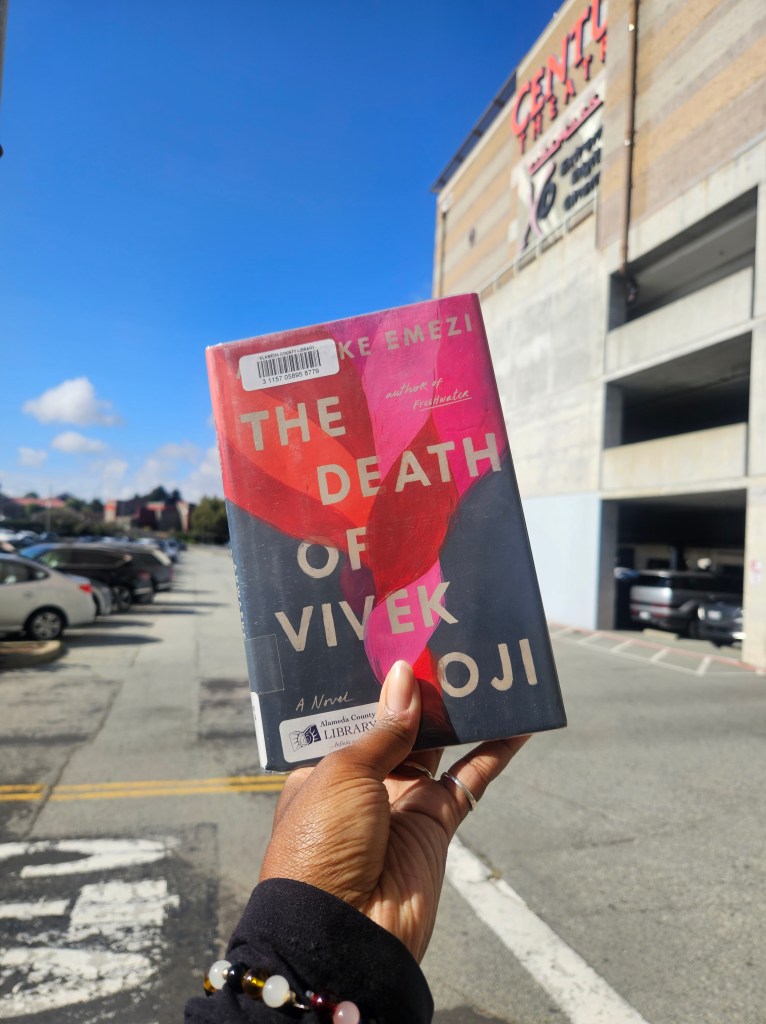
The Death of Vivek Oji (2020)
Emezi currently has a meme post on their Instagram account poking fun at readers who were shocked by Vivek’s death at the conclusion of this book given its titular implication, and I must confess, I fall into that camp of those who were indeed surprised to find Vivek dead at the end of the book.
As the book’s title does clearly implicate, this novel concerns the life and death of one Vivek. Like the title, the very first chapter sets us up clearly for the book’s content: “They burned down the market on the day Vivek Oji died.” There’s no ambiguity; Vivek is deceased. What follows is a multi-prong, multi-angled unwinding of Vivek’s life. In trying to describe the narrative to a co-worker, I shared that I visualized Vivek’s death as a central point on a map with multiple spirals of varied sizes curling outward from it in multiple directions. This visual captures the nature of Emezi’s storytelling: we get snapshots of communal history that pre-date Vivek and explain the formulation of the family unit he was born into. We hear from Vivek’s cousin, Osita, about the oddities and frustrations of a shared childhood with Vivek. We witness the increasing despair and destabilization of Vivek’s mother, Kavita, in the wake of her child’s death. We bruise alongside Vivek’s best friend, Juju, whose personal life was turned upside down not once but twice all before she’s knocked off course by the sudden death of her closest friend. And we also, occasionally and impactfully, hear from Vivek himself about the existential matters of his life and death.
Across twenty-four chapters and two hundred and forty-five pages we gain a wonky, kaleidoscopic picture of Vivek Oji, distorted by the love and lust of those around him: strange, unsettling fugues in his early youth, bullying and othering from peers in school, moods and distance in his early twenties before eventually, the unfurling of a soft, generous lover in his early adulthood. Then like sunlight through a foggy window, Vivek’s own voice intermittently shines through in chapters that begin microscopic—mere paragraphs rather than pages—to provide terrifyingly direct clarity. It is Vivek’s voice that closes the book with a placid acceptance that is both heartbreaking and heartwarming in equal measures.
Emezi’s writing is always thematically rich, and the central one that leapt from the page in The Death of Vivek Oji is the critical nature of autonomy; the idea that expectation and forced designation are the most spirit-crushing experiences of humanity. In chapter six, Vivek explains the presence of a book his mother finds in his room, The Beautyful Ones Are Not Yet Born by Ayi Kwei Armah: “I kept the book for the title, for how it was spelled. Beautyful. I had no idea why that spelling was chosen, but I liked it because it kept the beauty intact. It wasn’t swallowed, killed off with an i to make a whole new word…I wanted to be as whole as that word.” We come to understand Vivek was plagued by a yearning for fullness. And as we begin to see flashes of Vivek carving out their agency, we witness Vivek as a person more concerned with honoring his full self, his choice, his agency than with life itself.
Narratively, the story unfolds as an increasingly compelling mystery. As a reader, I found myself trying to trace back the spirals from the various narrators to the heart of Vivek. What hidden histories composed the contours of their lives and what events made up Vivek’s untimely death? Because we encounter so many narrators, all with limited, biased recollections, my investment in Vivek grew incrementally, such that I loved him most by the finale when it becomes clear that the end was inevitable.
Though I was devastated to find Vivek gone from this mortal coil at the story’s conclusion (sorry to disappoint, Emezi), I was also satisfied by a mystery solved and buoyed by the final thoughts Vivek leaves us with. Turning the final page feels like slipping beneath the surface of a lake on a warm day—a comforting, predictable embrace. Gravity will always win; Vivek was already dead.
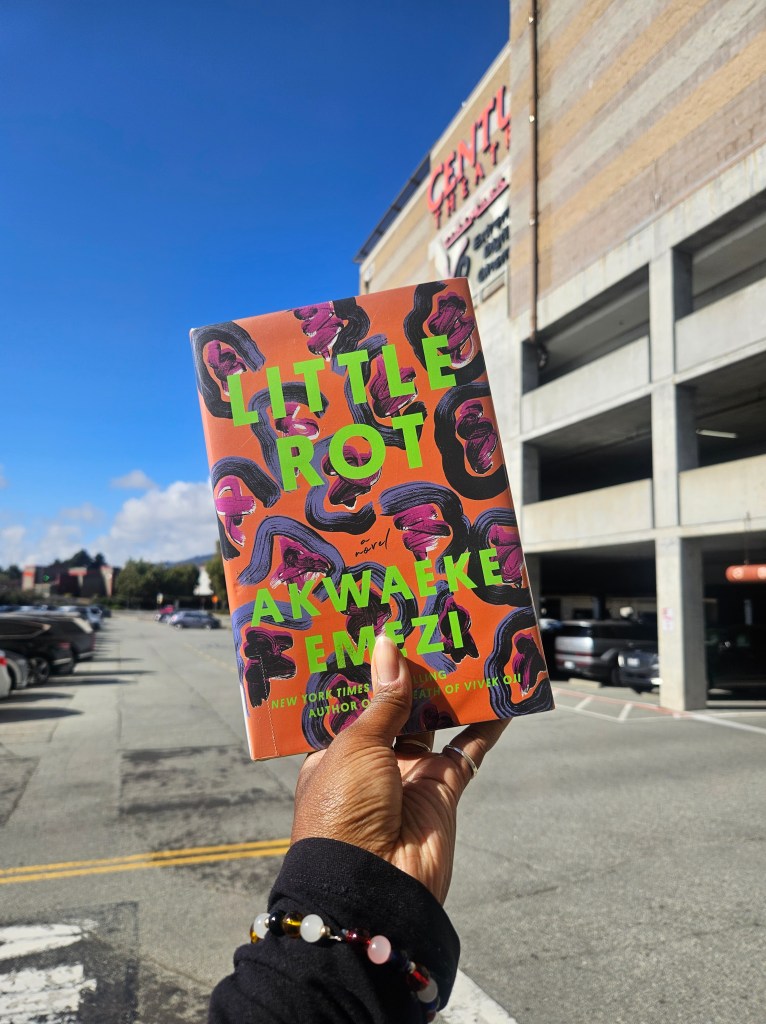
Little Rot (2024)
In contrast, reading Little Rot is the experience of riding shotgun in a driverless, brake-less vehicle that is steadily gaining speed on a sharp and steep decline. A tragedy of errors, the book circles a cast of six interconnected individuals over the span of forty-eight hours as multiple bad choices stack into a pile of kindling that surrounds them all before becoming a violent blaze.
On the book’s surface, location matters a lot. New Lagos is painted by all narrators as a lawless, vile city that encourages the worst impulses and celebrates crime. Deeper within the pages is the true heart of the matter: people are people no matter where you go. A perfect example of this truth is Aima, the first narrator we encounter in the story, who is reeling from a breakup with her long-term partner that she instigated after a recent resurgence of her Christian faith. Aima blames her previous abandonment of her faith on her brief international move to America where she met her ex, Kalu. But even once she’s returned to New Lagos, throughout the book we see certain consistencies in Aima: she’s suggestible, prone to blaming outside factors for her decisions, willfully naive. Like the other inhabitants of New Lagos, one’s environment is less important than one’s nature. Said another way: everywhere you go, there you are.
And so it goes throughout the book. Emezi’s talented pen brings each character to life in vibrant shades. Kalu: the spoiled, short-sighted ex of Aima and best friend of Ahmed. Ahmed: the hedonist, peddling sex but bereft of affection in his own life. Aima’s best friend Ijendu who is wealthy, careless and mysteriously well-connected. Souraya, the sex worker that Ahmed is deeply infatuated with, who struggles to reconcile her past with her present. And Souraya’s best friend, Ola: bold, deeply focused and distressingly jaded.
As I read, I made an effort to note each reference to rot which different characters make throughout the story, often in connection to the city of New Lagos but sometimes in allusion to their own mental states. We watch violence and impulse cannibalize kindness and grace to such an extent that finishing the book is to question the nature of humanity. Merriam-Webster defines the word as: “compassionate, sympathetic, or generous behavior or disposition; the quality or state of being humane,” though Emezi paints a picture of humanity as a darker, less magnanimous thing. Perhaps the most neutral assessment of humanity comes from Ola, who is asked to help right a moral wrong at personal expense. “[People] wanted revenge; they wanted people to be held accountable in a world where that just didn’t happen. It was like expecting a rotten tree to bear edible fruit. It was never going to give you that. It could give you other things, though, if you knew how to work the rot, if you weren’t afraid to touch it or use it. The rot could give you power.” There’s a nearly nonjudgemental neutrality in Ola’s assessment, an openness to take people as they come and adjust accordingly.
Ola, who others may regard as one of the most vicious characters in the book, has the most generous perspective on humanity. She takes humans as [the violent, greedy, selfish creatures] they are. Her viewpoint of rot—corruption—in others as simply a fulcrum from which to leverage is one of the most charitable perspectives in the story. Take that as the warning for this book’s dark contents that it is. Infidelity, corruption, human trafficking, child sex abuse, and homicide for hire all stack upon each other into a terrifying tower of violence across these pages. And when we reach the end of the nightmarish weekend in question, we’re left devastatingly hollow.
Pacing plays a large part in this feeling, as Emezi’s chapters are short and extremely action driven. Each turn of the page feels like an electrifying sprint to the next terrible decision. There’s also a humanizing intimacy to the multitude of perspectives written in first person; we’re never left unsure of a character’s motivations—however distasteful we may find them. The closeness with each character allows the reader to nurture truer empathy and richer disdain for the cast. Overall, it’s a quick, harrowing story that leaves readers with minimal light at the end of the tunnel.
Both books are affecting, leaving me reeling and reflective. Emezi is a genius: a master of their craft, an imaginative storyteller and deeply in tune with the breadth and depth of human experience. Where The Death of Vivek Oji feels like a bloodstained love letter to life itself, to the buoyant, transcendence of true love for self and others, Little Rot feels like an evisceration of optimism—bleak. These extremes are honest reflections on people though, and Emezi’s skill shines through to bring both stories to life captivatingly.
My next read is Kin by Tayari Jones for book club and a re-read of Heated Rivalry by Rachel Reid for trivia night—wish me luck! 🍀Also next up: I’m trying my first Hooptober Horror Movie Challenge this Fall, so stay tuned as I formulate my list and begin micro reviewing along the way!

