
Black Horror, Historical Fiction & Sci-fi: let’s get into it! 📚
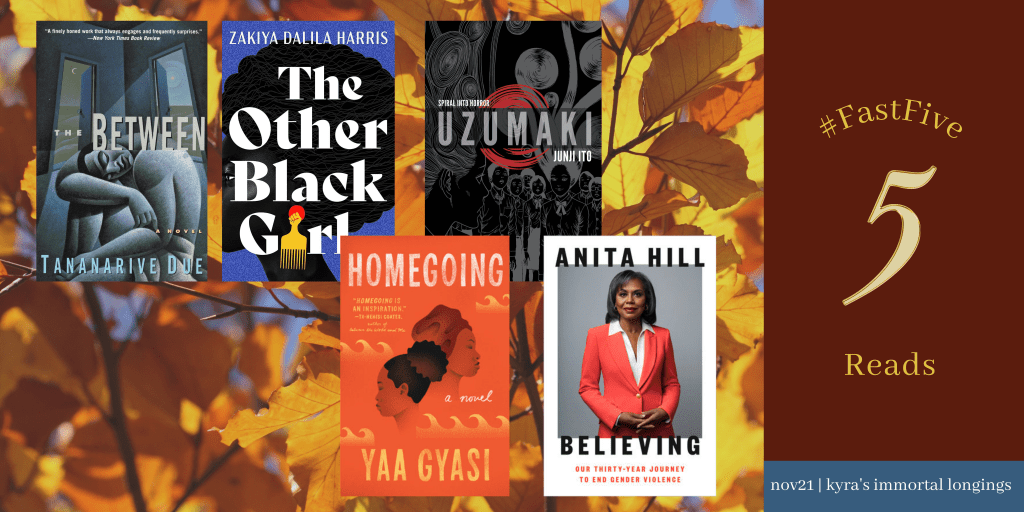
The Between by Tananarive Due #ColorMeObsessed (Harper Perennial, 1995) Horror
*content warning: death/grief, threats of racial violence
I was excited to dive into this revered classic in Black Horror, familiar with Due primarily by word-of-mouth and from her work on the Horror Noire documentary (free on Shudder, go watch! Right now!) Simply put—this book is terrifying. The night terrors are visceral; my heart rate increased as I read. The racial violence is (unfortunately) still palpable over twenty years post-publication. And Hilton is almost a perfect character to focus on from his traumatic childhood to his seemingly idyllic family life gilding a fraught marriage. Due crafts an engrossing story with a writing style that deftly pulls you into Hilton’s disintegrating mental state. Like Hilton, we have no idea which moments are real and which are a dream, memory, or mangled recollection. There are also the added spiritual and cultural aspects brought to us by believable characters and subtle imagery. As a Black horror fan, my only disappointment is that it’s taken me this long to touch one of Due’s classics—can’t wait to catch up on her catalog!
Homegoing by Yaa Gyasi #ColorMeObsessed (Vintage, 2016) Historical Fiction
*content warning: death/grief, slavery, sexual assault, violence, drug use
I know I am very late to the Homegoing party but it is still a magnificent one! Gyasi’s masterpiece follows two related genealogies through eight generations from Ghana in the 1600s to modern day America, skipping stones over the intricacies of inter-Ghanaian slave trade, political violence, and addiction. As dark as the settings and themes may be, Gyasi’s talent lies in her empathetic writing; she wraps the ongoing, interconnected narrative in absorbing vignettes, snapshots in the lives of the sixteen different characters whose motivations and dreams are timelessly human. I especially appreciated the subtle cultural developments we watch as the lineages continue over time; as a Black American, it was a treat to watch the Ghanaian dialects become African-American Vernacular English over a few decades, eventually becoming the language I speak and love today. Gyasi’s narrative smoothly prompts us to observe what evolves and what remains over time, how events shift tradition and intergenerational memory. Truly a rich, moving novel.
The Other Black Girl by Zakiya Dalila Harris #NothingToSeeHere (Simon & Schuster, 2021) Science Fiction
*content warning: police shooting
This novel was dizzyingly unimpressive. What perhaps could have been a unique political, racialized spin on The Stepford Wives was instead a messy, lengthy stew of click-bait based superficial opinions. The main character, Nella, has the personality of a 16-year old Tumblr blogger right out of 2012—so out of depth and helpless is this protagonist, and we unfortunately spend the first two thirds of the book wading through her honestly unimportant subconscious—her memories and paranoia only serve to jumble the reader without providing much interesting content. The book was perhaps most acutely disappointing because it has the bare bones of something really fun: Harris turns a staple of Black women’s existence, hair grease, into a tool of villainy, the antagonist, Hazel, is easy to hate, an obvious and ruthless bully, and there’s a shiny conspiracy theory to tickle our imaginations. But without any interesting fodder to pull these facets together, they remain as misplaced and useless as Nella. Alas, the true villain here is Harris’ heavy-handed writing. I can’t help but wonder who on Earth was this book written for? Is it meant to probe the science fiction buffs? The well-meaning White reader? Is this meant to be entertainment or a lesson? It’s unclear what Harris wanted to say here besides “look how hard it is to be Black in corporate America,” but baby everyone already knows that…
Believing: Our Thirty-Year Journey to End Gender Violence by Anita Hill #NothingToSeeHere (Penguin Random House, 2021) Non-Fiction
*content warning: sexual assault, sexual harassment, stalking, verbal harassment
This book is especially outside of my wheelhouse—I avoid reading non-fiction in my free time, but my book club chose this book and I was eager to join the discussion. This was my first time reading Hill, and I think she’s an accessible writer—she made the data and content easy to understand and seemed to invite the reader into dialogue with her by differentiating her personal opinions from general political interpretations. I also appreciated her candid retelling of her famous congressional testimony, as I can’t imagine anyone picking up this book and not being interested in hearing her opinions of the experience and aftermath. Despite these boons, I found her argument unconvincing based on the evidence she presented. This wasn’t a terribly bad read, it also just wasn’t a terribly good one.
Uzumaki: Spiral into Horror by Junji Ito (VIZ Media, 2010) Horror
*content warning: gore, body horror
Ito is the author who provoked my interest in horror manga; I’ve been reading his comics online for years and his work is always frightening. The Uzumaki collection falls in line there—less psychological than some of his other works, I would describe the drawings and concepts themselves as the most jarring aspects of this series. Loosely held together by the premise of “a town overrun by spirals,” each subsequent story shows a bizarre and wicked degradation of reality as humanity, flesh and space itself are carved away. Ito’s drawings are nightmare-fuel.
And that wraps another #FastFive Have you read any of these books? Have a recommendation to share? Drop a comment & share your thoughts! 💬
- Committing to #HopeCore (For Now): A Saturnian Return to Form
- 2026 Cinema Began with a Bust
- Windows and Mirrors: Spike Lee’s Highest 2 Lowest (2025) vs. Akira Kurosawa’s High and Low (1963)
- Skip It, Screen It or Stream It • July 2025
- A Dazzling Dance with the Devil: The Spoiler-FULL Sinners Review 🌕
 Kyra's Immortal Longings: Life As It Comes
homegoing sounds so intriguing!
LikeLike
I’d definitely recommend it; Yaa Gyasi weaves a great tale. Thanks for reading my review! 🙂
LikeLike